

Wellington is currently building very little housing. Per capita, the city lags behind almost every other municipality in New Zealand. This consistent under-supply of housing leads to a troubling dynamic. When demand is high, the city’s economy grows but house prices spiral out of control, reaching $1,250,000 in early 2022. Meanwhile when demand is low, housing becomes more affordable, but the city becomes a worse place to live: fewer jobs, shrinking population, less vibrancy. Until Wellington starts building more housing, it won’t be able to escape this trap – it will never return to being both affordable and desirable.
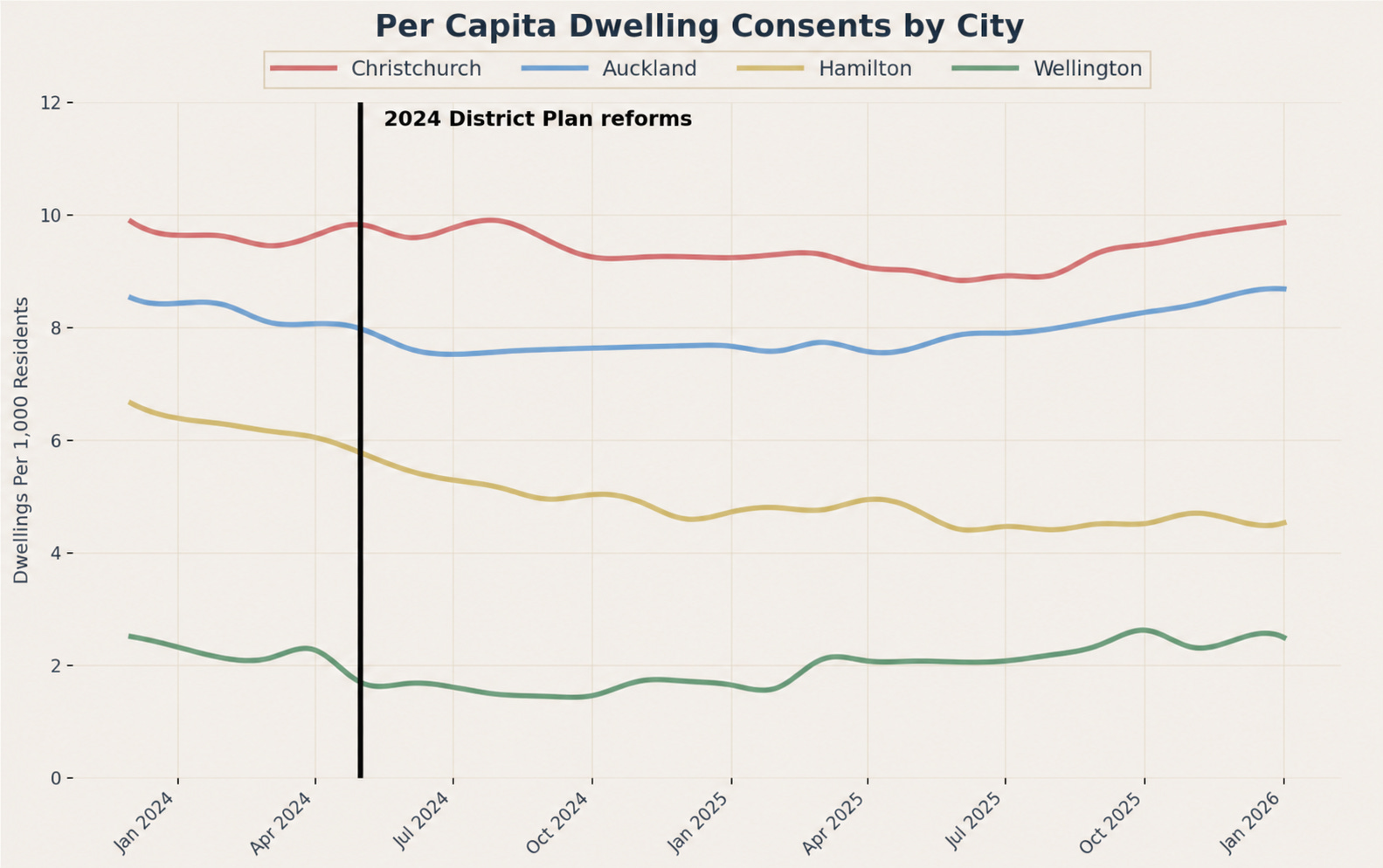
The 2024 District Plan was supposed to address this problem, by zoning for more medium and high-density housing across the city. Unfortunately, it’s been nearly two years and we’ve seen little sign of improvement relative to other cities.
It appears that simply legalising this kind of housing was not enough: we need to make it financially viable to build. We need to stop taxing development and rewarding empty lots.
Wellington City Council raises revenue by levying rates on the capital value (CV) of properties. It’s well-understood that this creates a disincentive to development, since doing so incurs a higher tax burden. On the other hand, levying rates on land value (LV) does not create this disincentive, leaving property owners free to use their land more productively. Switching from the current system to Land Value Rates (LVR) would thereby lead to an increase in the supply of housing.
What’s less often talked about is that this problem is not binary, and it’s been getting much worse over time. Levying rates on CV is a disincentive to development in proportion to how high the tax rates are. If the average rates bill was only $1 the disincentive to development would be approximately zero – switching to LVR wouldn’t make a difference. On the other hand, if the average rates bill was $50,000 a year, the cost would be so debilitating as to make every possible housing project financially unviable and switching to LVR would be the only way to get any private housing built at all.
So, why has Wellington consistently seen low rates of housing construction, despite the new District Plan? It is likely due to the fact that Wellington’s effective tax rate on housing has doubled in the last four years. Wellington is now significantly ahead of other major NZ cities in terms of how much it penalises development. Auckland has an effective tax rate on capital improvements of just 0.35%, which is roughly where Wellington was a few years ago. Since then, Wellington’s rate has risen to a staggering 0.74% per annum. With a tax rate that’s over twice as high as Auckland, it’s no wonder that Auckland is wiping the floor with Wellington when it comes to new dwelling consents.
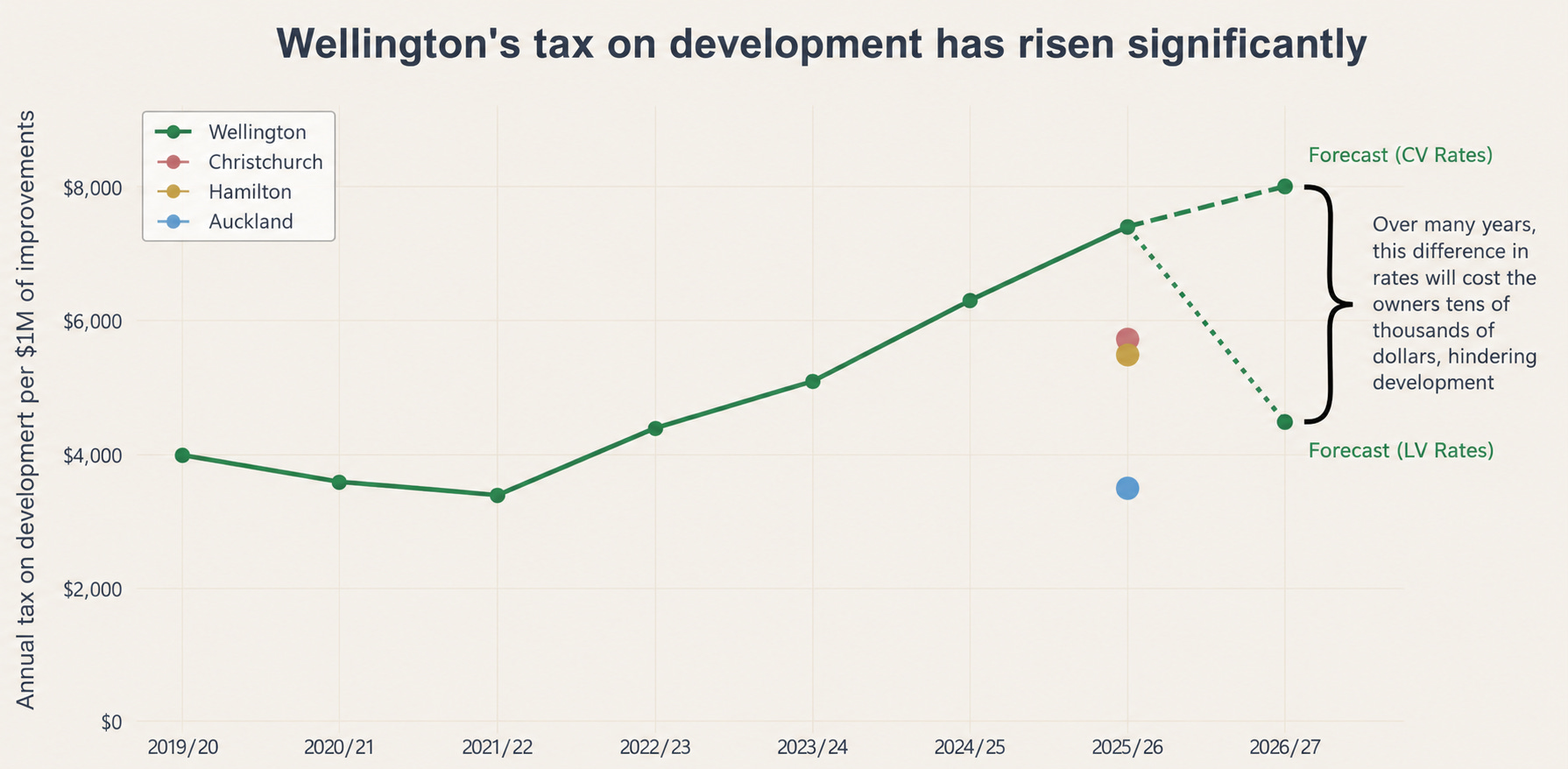
To make these numbers more concrete, what does a 0.74% effective tax rate actually mean? It may sound like a small number, but the effects are significant. For a developer who is building housing to be put up for sale, higher rates mean a lower sales price, since people are less willing to pay for an asset that comes with a higher yearly cost attached to it. This can severely eat into a developer’s profit margin. If we consider the construction of a new apartment in central Wellington with improvements worth $1,000,000 and a reasonable discount rate of 6%, then this tax reduces the developer’s profit by $44,000. Of course, that’s not including Developer Contributions and all the other various costs imposed by local and central government. All up, the total cost to developers as a result of CV rates, taxes and fees could be in excess of $70,000. When you put it like that, it should be easy to see why no one is bothering to build housing in Wellington. It’s simply not a good way to earn money. Wellington has taxed development out of the city, and it’s now all happening elsewhere in New Zealand.
The city essentially has three options going forward.
First, Wellington could accept its current anemic rate of housing construction, and slip further into decline. More and more of Wellington’s brightest young minds will leave for better opportunities elsewhere. Eventually, the city will be overtaken in population by Hamilton and Tauranga, and will lose what is left of its vibrancy.
Second, Wellington City Council could somehow cut council spending in half, thereby creating the fiscal capacity to reduce the tax on housing to a more manageable level. Of course, this would need to be done without getting rid of all the good work the council does to make Wellington function. This seems highly implausible.
Third, Wellington City Council could switch to rating on land value, immediately slashing the tax on development without losing a cent in revenue. The average ratepayer would even see their rates bill go down. Over time, more housing will get built, and Wellington’s economy will start growing again, while affordability will continue to improve.