

With all the votes from the October local elections counted, Wellington’s voters have delivered a clear mandate. They want an affordable city and they want a fairer rating system, and now is the time to make it happen.
Most candidates who supported Land Value Rates were elected, and the new council will have ten councillors who are supportive of enacting LVR, out of sixteen. That’s an increase of two from the previous council. The Independent Together group, who were the strongest voice against LVR, performed terribly, failing to pick up any seats and very nearly losing the one councillor they had.
Of course there were many other issues at play in this election, so it would be wrong of us to say that the result is significantly due to people’s views on the rating system. But we think it also speaks well of this policy that it is so widely supported by the candidates who triumphed earlier this month – candidates who are good at connecting with their community, who have well-thought-out positions on the issues and who listen to what this city needs. Many of these councillors, both incumbents and those newly elected, back Land Value Rates because of the simple fact that it will work to make Wellington more affordable and a better place to live.
So, having said all that, let’s take a closer look at how our pro-LVR candidates fared.
Mayor
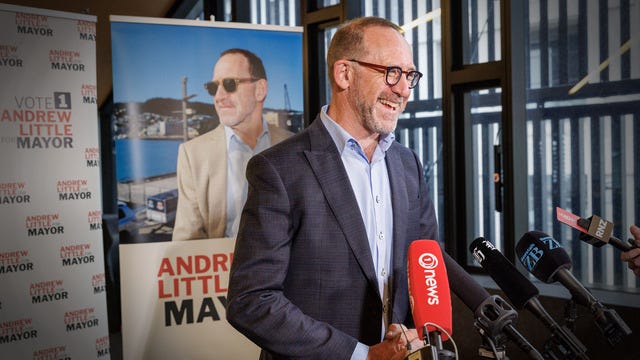
Andrew Little winning the mayoralty was not a surprise to us. Andrew Little winning with a whopping 56% of the first preference votes was a surprise, and a testament to his strength as a candidate. Andrew has said he supports LVR in principle and has pledged to investigate it. We hope his landslide victory will give him more confidence to push ahead with this policy. We are also heartened to see Alex Baker come third with 9% of the vote. Alex made LVR one of the main policy planks of his campaign, so it’s great to see him get a solid share of the vote at the same time as Andrew’s landslide. Between the two of them, that’s 65% of the vote for candidates who are supportive of LVR.
Takapū/Northern Ward
This race was pretty incredible. Labour councillor Ben McNulty has been an advocate for LVR on council and you can see the video we did with him about the policy here. Like Andrew, we expected him to win but were pleasantly surprised at the magnitude of the victory. Ben easily broke the record for biggest STV win ever in Wellington, and got over four times as many votes as the next placed candidate. It’s no exaggeration to say that Ben’s second preference votes essentially dictated who else got elected in this ward. We are stoked that the voters of northern Wellington are apparently big fans of Ben just as we are.
Wharangi/Onslow-Western Ward
Rebecca Matthews has been one of our biggest allies on the city council and a bold pro-housing voice for many years. Despite a change in party affiliation from Labour to the Greens, Rebecca was easily re-elected, with significantly more votes than three years ago. We think this is a testament to her strong personal brand and the power of pro-housing politics. At the same time, Labour candidate Joy Gribben came agonisingly close to beating Ray Chung, ending up just 45 votes short after all the special votes were counted. As part of the Labour team, Joy is committed to investigating LVR and we are sorry to see her not on council.
Pukehīnau/Lambton Ward
This ward easily elected two councillors who are supportive of LVR – Geordie Rogers and Afnan Al-Rubayee. In particular, Geordie has been a great advocate for LVR in his eighteen months as a councillor and before that as President of Renters United, and it was great to see him talking about this policy during the campaign. Despite there being eleven candidates in this race, Geordie and Afnan got a majority of the first preference votes between the two of them. We’re also grateful to Tim Ward, who placed fourth, for his support of LVR. Overall, this central city ward, with its large renter population, delivered one of the strongest mandates for pro-housing policies such as LVR.
Motukairangi/Eastern Ward
With none of the three incumbent councillors standing for re-election, this race was a bit of a free-for-all. It was very hard to know who might get elected, but thanks to a lot of hard work, two of the three spots went to pro-LVR candidates: Sam O’Brien and Jonny Osborne. Part of what made their victories possible was second preference allocations from two other pro-LVR candidates who missed out: Alex Baker (who also ran for Mayor) and Trish Given. The eastern suburbs were blessed to have so many great candidates, but unfortunately that does mean not all of them can win and we want to say a big thank you to Alex and Trish for their support.
Paekawakawa/Southern Ward
The Southern Ward delivered the clearest pro-LVR result of any of the general wards – councillors Nureddin Abdurahman and Laurie Foon both support LVR and were re-elected by a landslide. They received a collective 73% of the first preference votes, and we look forward to them continuing to support pro-housing measures on the city council.
Te Whanganui-a-Tara Māori Ward
Both of the major candidates in this ward, Matt Reweti and Tory Whanau, are broadly supportive of LVR. As a result, we would’ve been happy to see either of them elected. In the end it was Matt who won, and we think he will be a great councillor.
Conclusion
Adding up all these results, it’s clear that Wellington has delivered a clear mandate for pro-housing politics, including Land Value Rates. We urge the newly elected city council to take action on this policy, so that Wellington can get back to being the affordable and thriving city we all know it can be.